Making the Military Moral by Don Carrick James Connelly David Whetham
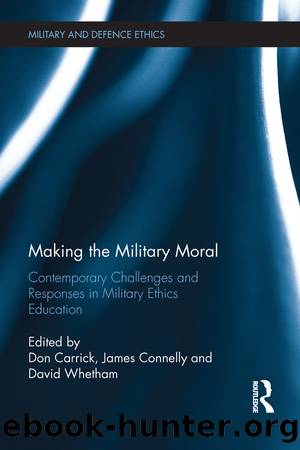
Author:Don Carrick, James Connelly, David Whetham [Don Carrick, James Connelly, David Whetham]
Language: eng
Format: epub
ISBN: 9781472412164
Barnesnoble:
Publisher: Ashgate Publishing Ltd
Published: 2014-02-28T00:00:00+00:00
The concept of moral expertise
Military personnel are professional where they demonstrate competency and expertise in carrying out their professional duties to provide a service to society that society cannot otherwise provide for itself. The concept of duty, derived from moral service and purpose, presupposes knowledge and understanding of the expert requirements of that service: that which needs to be known and those skills to be developed. Case et al. (2010: 3â4) identify four major areas of professional military expertise in their discussion of the US Army â military-technical, political-cultural, human development and moral-ethical. The Ethic inhabits this latter realm, which directs the military in its deployment of the rest of its expert knowledge in order for it to âfulfill the fundamental duty of the profession to fight wars and conduct operations morallyâ, in accordance with the expectations of the people and the requirements of domestic and international law.
What separates the military profession from all others has been bluntly expressed by Toner (1995: 22â23): âin addition to killing and being prepared to kill, the soldier has two other principal duties ⦠some soldiers die and, when they are not dying, they must be prepared to dieâ.10 In being prepared to inflict harm and take life, and to accept the âunlimited liability clauseâ of giving their lives for their country, military professionals cross the most fundamental of moral premises, the right to life. But they must do this in accordance with the values and interests of the society that they support, and those moral principles that underlie them. The âlicenseâ to cross these moral boundaries is dependent on clearly defined constraints on what are deemed morally permissible behaviours in relation to necessary moral ends, which establishes high expectations of moral knowledge and skills in the prosecution of professional activity.
It is in the realm of moral expertise that the question of professional autonomy is most clearly raised. The military, as a profession, defined in part by its ability to make judgement within its area of expert knowledge and skills, has a duty to provide those it serves with expert advice on the use and threat of force. In moral terms this involves resisting obedience to those civil proposals and policies that promote the unprincipled use of force (what Cook (2004: 63) describes as âa high manifestationâ of military professionalism) and exposing them to policymakers through expert and plain-speaking guidance (Cook 2013, 33â44). However, public confidence, not least in the UK and US, in the appropriate utilisation of expertise and knowledge by military professionals has been challenged by reports of inappropriate government lobbying by senior and retired officers, and questionable military relationships with the media and defence industry (Haynes and Pitel 2012: 9), facilitated in the latter case by the ârevolving doorâ of appointments for retiring military officers in the private sector. Clarity on the acceptable utilisation of professional knowledge is part of societyâs bargain with the military and is underpinned, for liberal democracies at least, by the publicâs belief in the âapolitical and non-partisan ethic of serviceâ and âthe principle of civilian controlâ (Moten 2010: 17).
Download
This site does not store any files on its server. We only index and link to content provided by other sites. Please contact the content providers to delete copyright contents if any and email us, we'll remove relevant links or contents immediately.
The remains of the day by Kazuo Ishiguro(9002)
Tools of Titans by Timothy Ferriss(8402)
Giovanni's Room by James Baldwin(7351)
The Black Swan by Nassim Nicholas Taleb(7136)
Inner Engineering: A Yogi's Guide to Joy by Sadhguru(6798)
The Way of Zen by Alan W. Watts(6619)
The Power of Now: A Guide to Spiritual Enlightenment by Eckhart Tolle(5788)
Asking the Right Questions: A Guide to Critical Thinking by M. Neil Browne & Stuart M. Keeley(5778)
The Six Wives Of Henry VIII (WOMEN IN HISTORY) by Fraser Antonia(5518)
Astrophysics for People in a Hurry by Neil DeGrasse Tyson(5194)
Housekeeping by Marilynne Robinson(4453)
12 Rules for Life by Jordan B. Peterson(4308)
Ikigai by Héctor García & Francesc Miralles(4277)
Double Down (Diary of a Wimpy Kid Book 11) by Jeff Kinney(4276)
The Ethical Slut by Janet W. Hardy(4261)
Skin in the Game by Nassim Nicholas Taleb(4255)
The Art of Happiness by The Dalai Lama(4132)
Skin in the Game: Hidden Asymmetries in Daily Life by Nassim Nicholas Taleb(4010)
Walking by Henry David Thoreau(3966)
